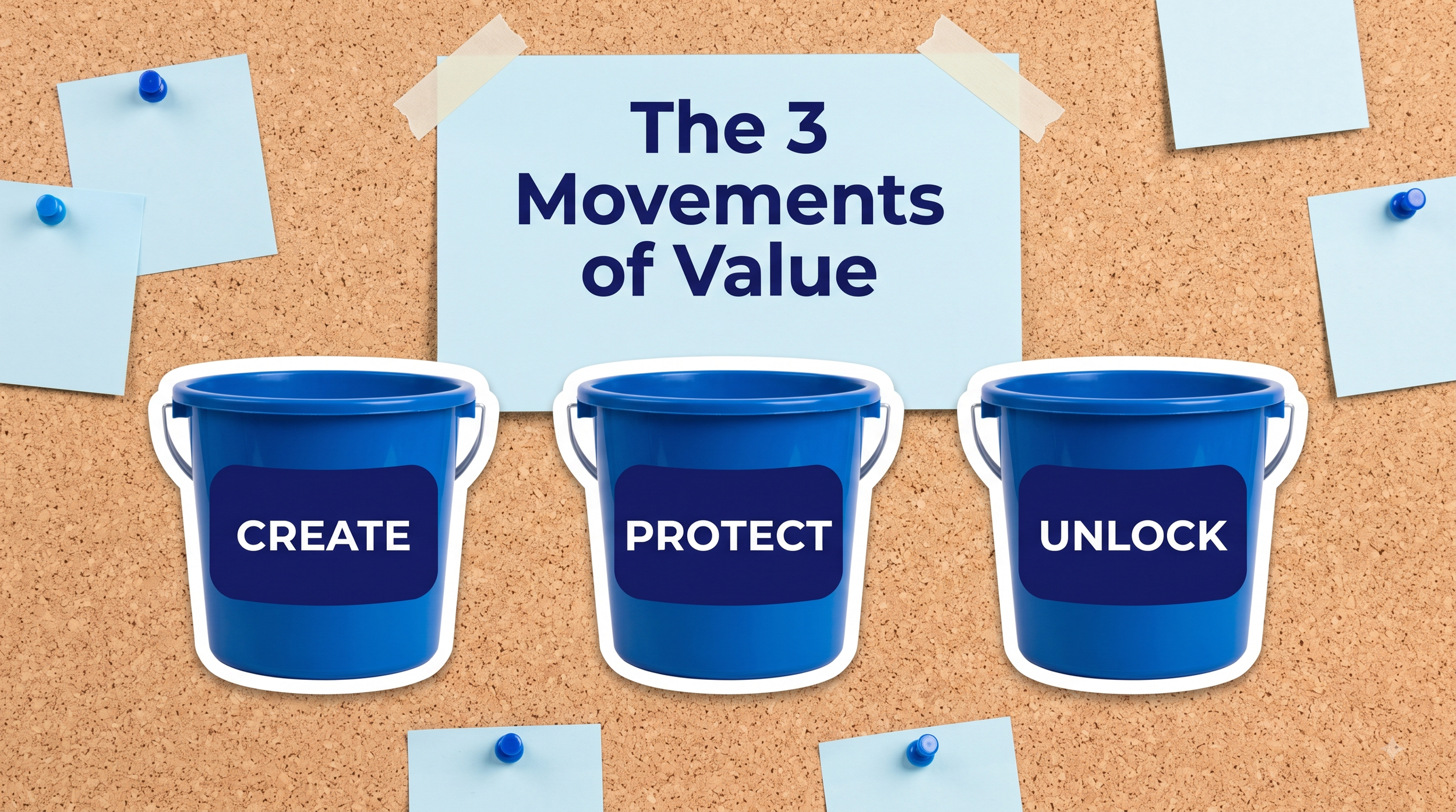
The 3 Movements of Value: Create, Protect and Unlock
Every manager inherits processes, systems and routines. Leading is something else: deliberately deciding what value will be generated — and for whom.
Every manager inherits something: processes, systems, routines, structures, teams — a legacy of decisions made by others, in other contexts, for other problems. In the public sector this inheritance is even heavier: it comes wrapped in regulation, custom, and "it's always been done this way".
The natural consequence is that the manager's energy is consumed by administering what exists: keeping things running, fighting fires, improving at the margins, not letting anything break.
Administering the existing is necessary — but it is not leading.
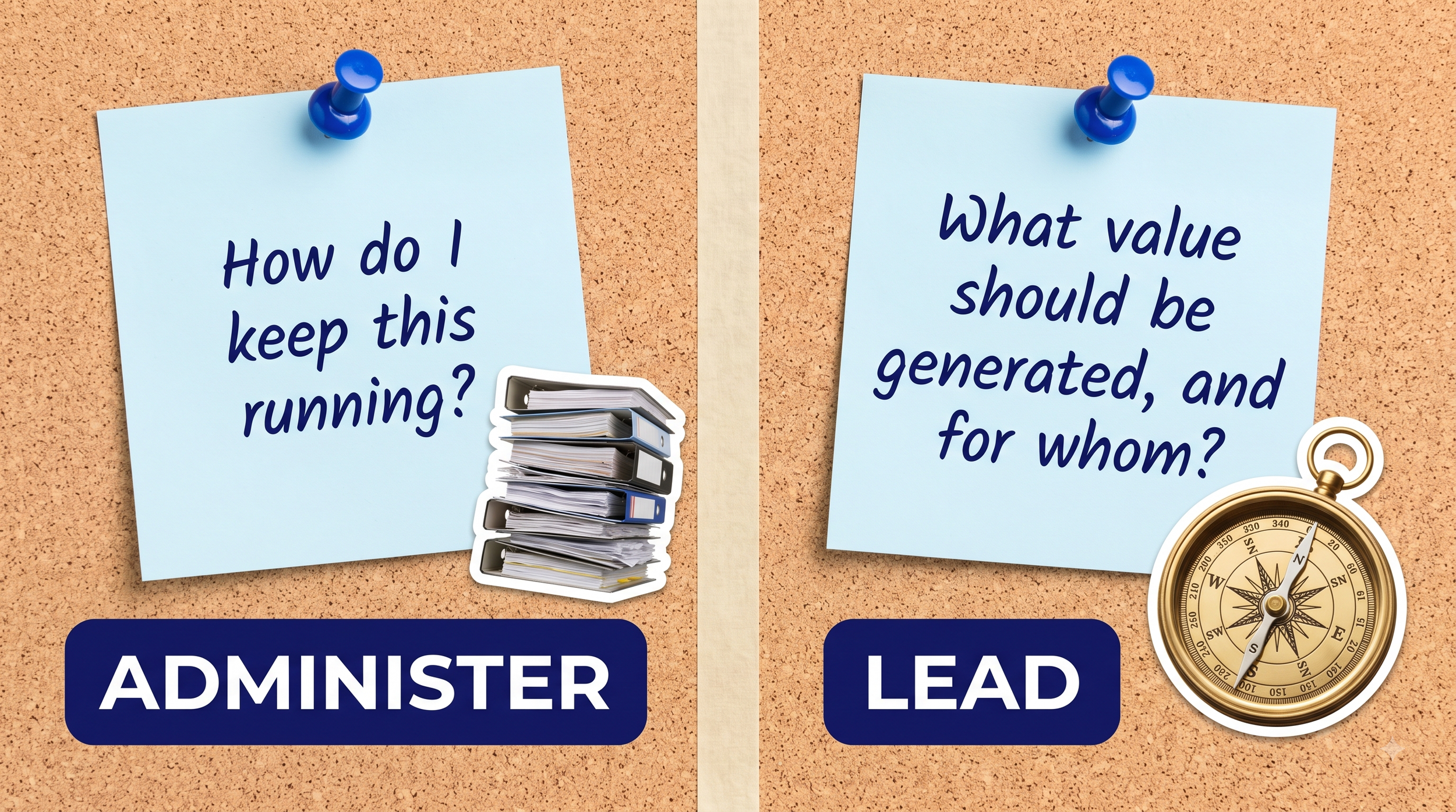
The administrator's question is: "how do I keep this running?"
The leader's question inverts the order: "what value should be generated, and for whom?" — and only then: what to keep, what to change, what to abandon.
This inversion is the foundation of a framework we have been using with public institutions in Brazil, now part of the OKR+ body of methodology at Oxford Business Masters: The 3 Movements of Value.
The central idea is simple: in the day-to-day reality of an institution, value is always in one of three states — and the leader's role is to act deliberately on all three.
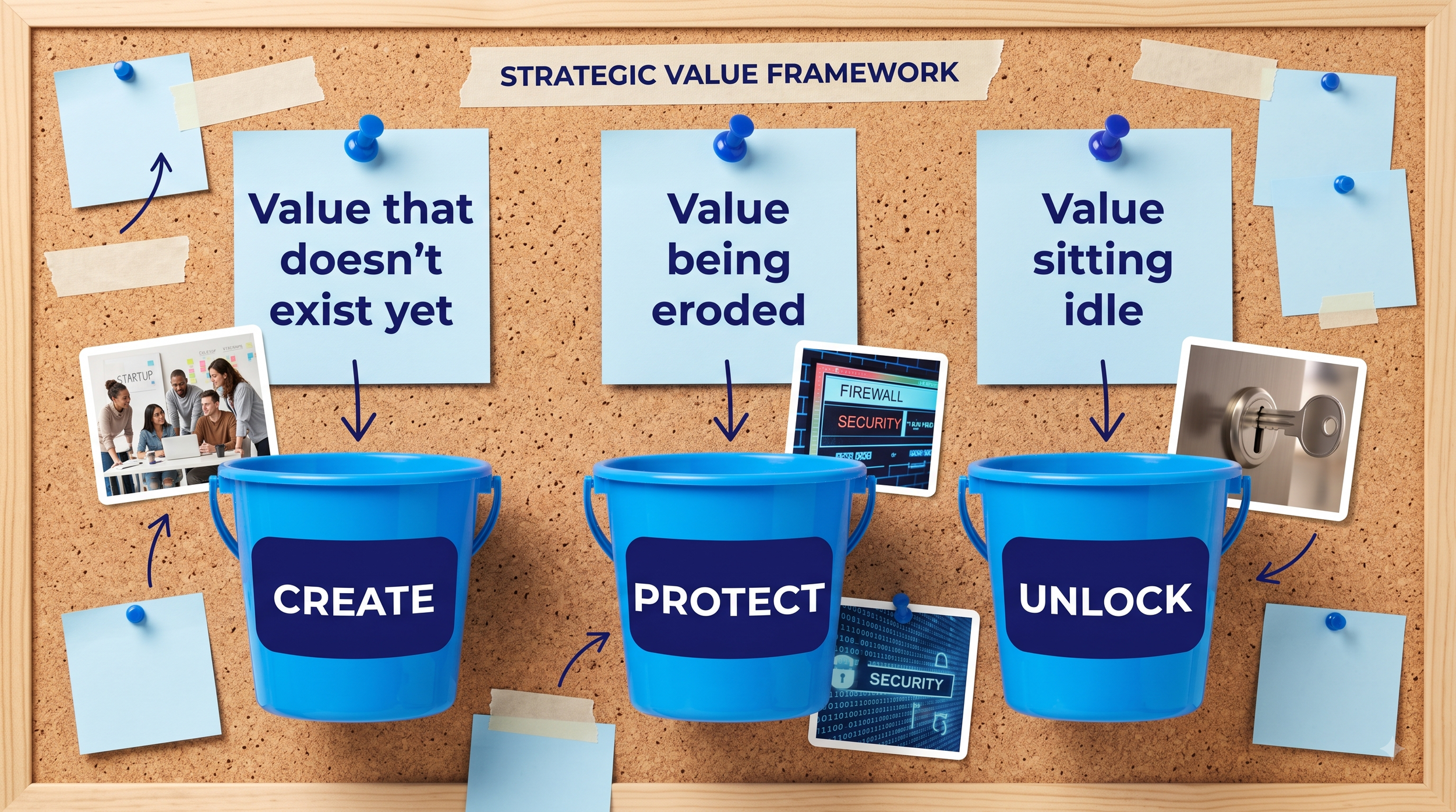
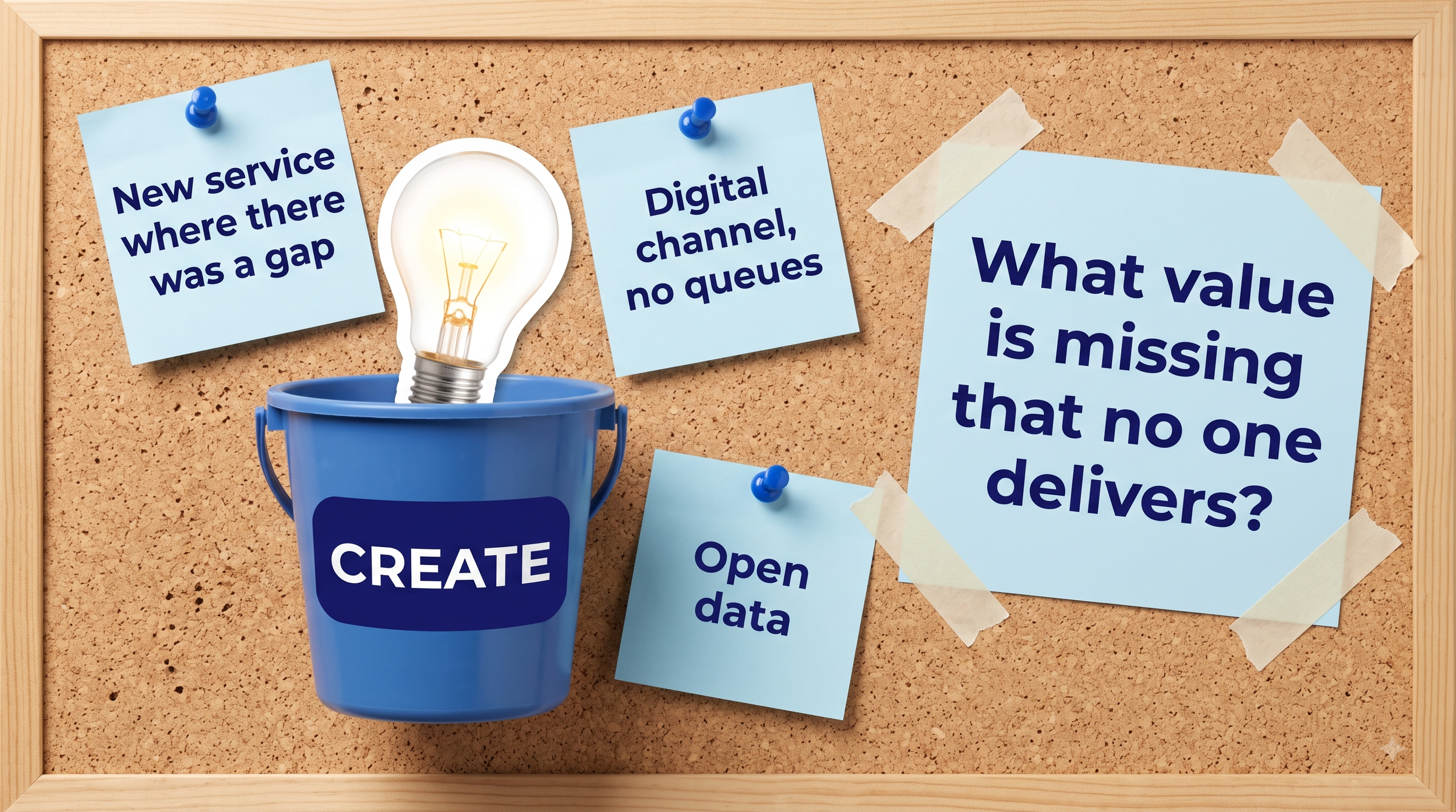
Movement 1 — CREATE value
Finding new — and preferably innovative — ways to generate value that did not exist. It is the most visible movement, the one most associated with innovation, and therefore the easiest to communicate.
In the public sector, creating value takes many forms: a service that starts to exist where there was a vacuum; a digital channel that eliminates the citizen's trips to the counter; open data that enables academia, the press and civil society to create value the institution itself would never create; an inter-institutional partnership that produces a result neither party could achieve alone.
The leader's question: what value do our stakeholders need that no one yet delivers?
Movement 2 — PROTECT value
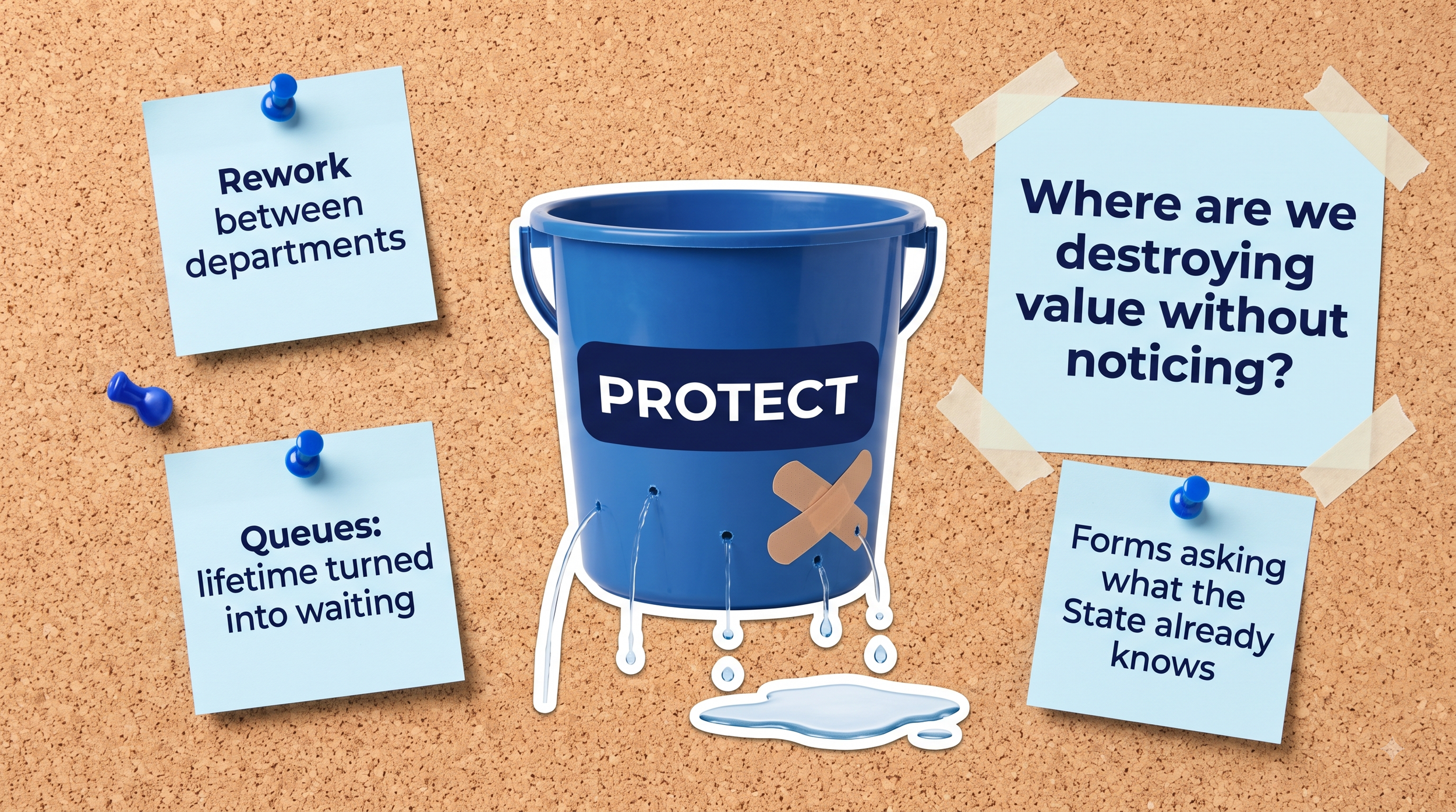
This is the most invisible movement — and, for public sector leaders, the most revealing.
Value is destroyed every day without anyone deciding to destroy it. There is no villain, no act, no decision: only the accumulated friction of processes no one designed end-to-end. And precisely because no one is "guilty", no one sees it.
The silent destruction of value is everywhere: the citizen who must show up three times to resolve what would fit in one visit; the form that demands information the State already holds; the rework between departments that don't talk to each other; the qualified public servant consumed by mechanical tasks a system could do; the recurring meeting that decides nothing — multiplied by the hourly cost of everyone present; the queue, converting citizens' lifetime into waiting.
Protecting value means reducing this destruction: eliminating friction, rework and waste.
The leader's question: where are we destroying value without noticing — and how much of that destruction has been normalised as "that's just the process"?
Movement 3 — UNLOCK value
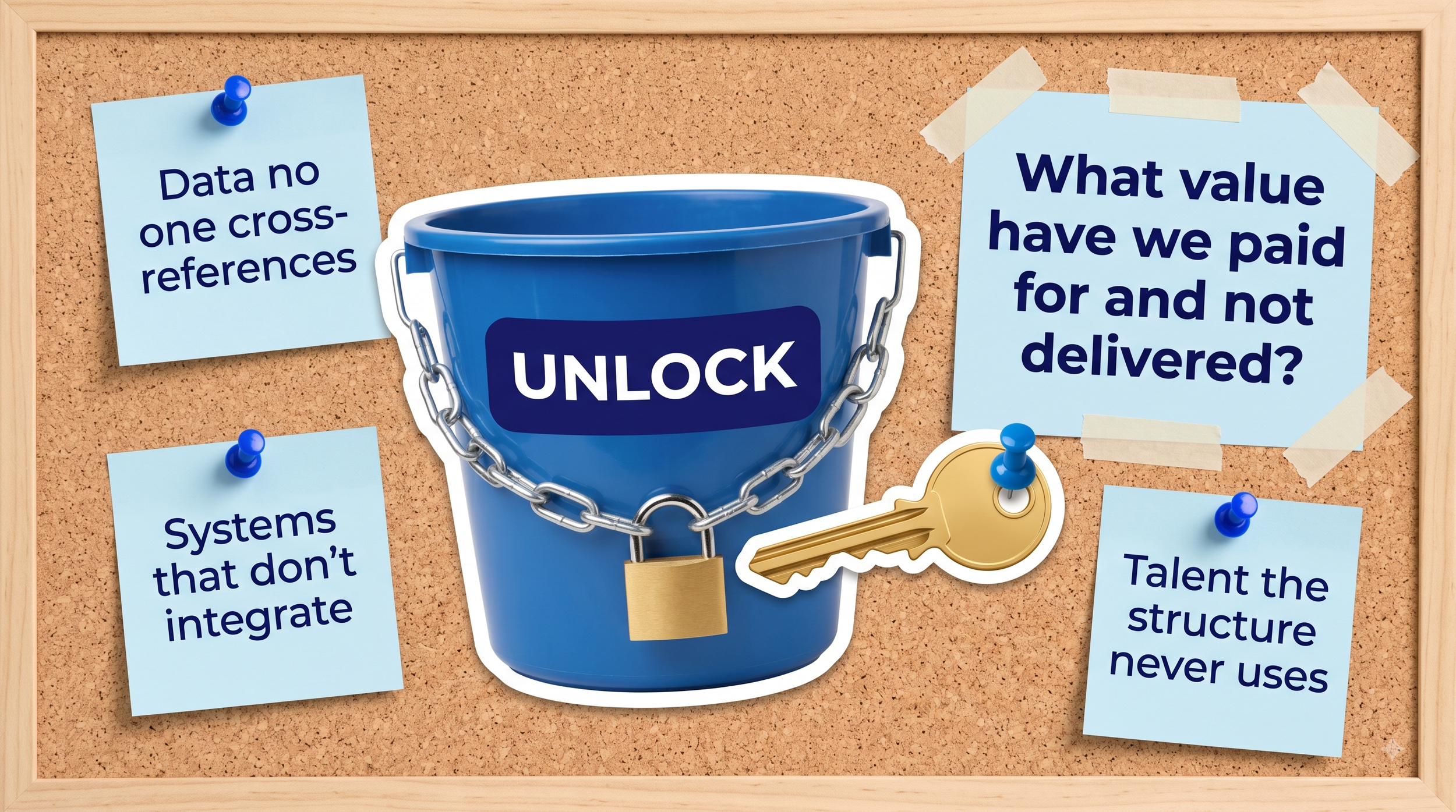
The value that already exists, has already been paid for by the taxpayer — and is sitting idle. It doesn't need to be created; it needs to be released.
In the public sector, where creating new value runs into budgets, legislation and political cycles, unlocking is often the movement with the highest return per unit of effort — precisely because the resource already exists.
Locked value is everywhere too: data collected for years that no one cross-references or analyses; systems that don't integrate — each holding a fraction of what, together, would be strategic information; skills the formal structure never uses (the statistician assigned to the mailroom); idle physical assets; knowledge that doesn't circulate — the solution one department found while another department is, right now, trying to reinvent it.
The leader's question: what value have we already paid for and not yet delivered to anyone?
Value for whom? The stakeholder lens
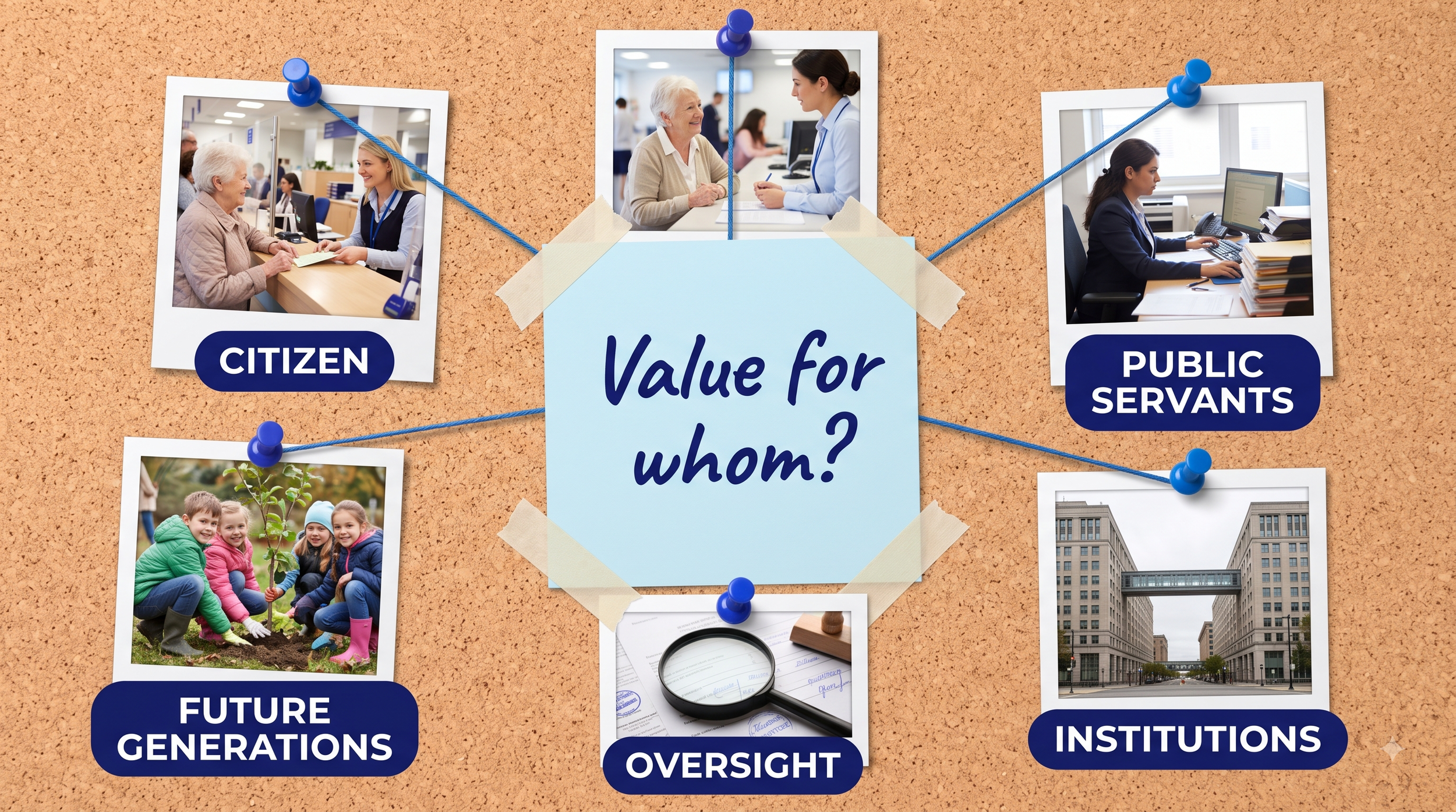
The three movements only make sense when they answer the question "value for whom?".
The minimum map of a public institution includes the citizen — the institution's reason to exist and the final recipient of all value; the public servants — the internal stakeholders, often the most forgotten, because value destroyed in the servant's experience ends up destroying value at the front line; the other institutions in the chain — no one delivers public value alone, and value often gets stuck precisely at the borders between bodies; the oversight bodies, whose legitimate value is compliance and the protection of public funds; and society and future generations — the stakeholder with no voice in today's meetings.
And here is the honest provocation the framework must sustain: sometimes, generating value for one stakeholder destroys value for another. Excessive control protects public funds and destroys agility for the citizen; the productivity target speeds up delivery and erodes the servant's experience. Leading is not denying the trade-off — it is making it consciously, instead of by inertia.
What this changes in your OKRs
In OKR+, this lens becomes operational at three points.
The Objective as a declaration of value. A good Objective makes explicit what value will be generated and for which stakeholder. An objective that doesn't let you identify the recipient of the value is a continuity objective in disguise.
The KR as evidence of value delivered. Key Results are the measurable evidence that the value reached the stakeholder. "12 processes digitised" measures effort; "citizen waiting time reduced from 40 to 10 days" measures value delivered.
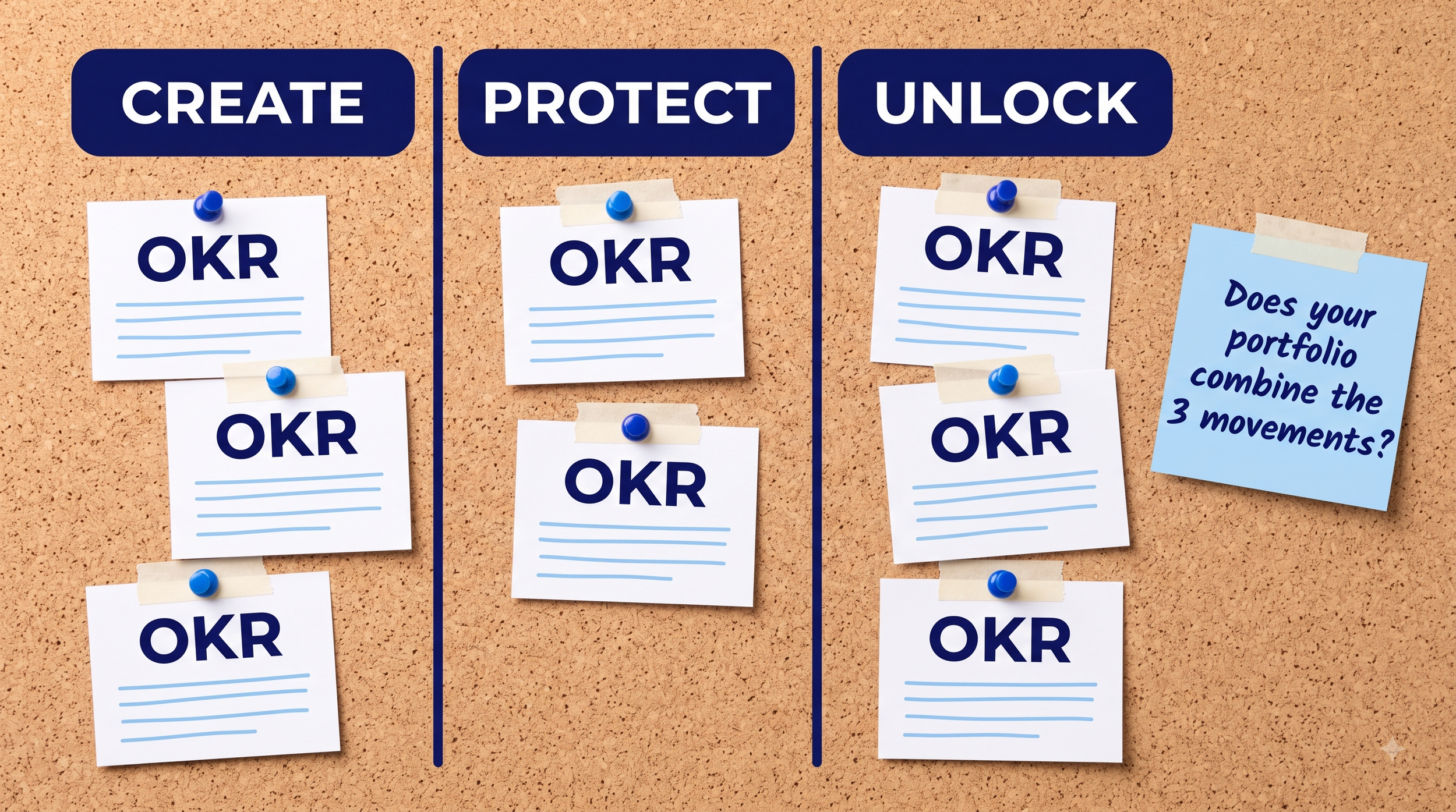
The portfolio audit. The most powerful application of the framework is as an audit lens: classify each OKR in your portfolio into one of the three movements. The diagnosis is immediate. If all OKRs are continuity ("maintain", "keep going", "improve by 5%"), the institution is administering, not leading. If all are creation, the institution may be ignoring the silent destruction of value and the locked value — the movements with the highest short-term return. A healthy portfolio combines the three movements deliberately, not accidentally.
Refusing to merely administer
Leading with OKRs is, in the end, this: refusing to merely administer what you inherited.
The "3 Movements of Value" framework is part of the OKR+ body of methodology at Oxford Business Masters, developed from the value creation thinking of Gautam Mahajan and the Creating Value movement (Creating Value Alliance).
Want to apply this lens to your institution's OKR portfolio? Talk to Oxford Business Masters: www.oxfordbmasters.com
The 3 Movements of Value don't ask for more resources, more structure or more time. They ask for a different question at the start of each planning cycle: what value will we create, what value will we protect and what value will we unlock — and for whom?
